Example Of A Formal Letter . Martin haynes or dear ms. Most formal letters are no more than one typed page. 35 Formal / Business Letter Format Templates & Examples ᐅ TemplateLab from templatelab.com Here are the rules in proper formal letter writing. My name is john treece; Definition of a formal letter.
Alteryx Batch Macro Example. Some tools in the tool palette are macros. This is the second post in a series aimed at making the three types of macros in alteryx accessible to anyone:
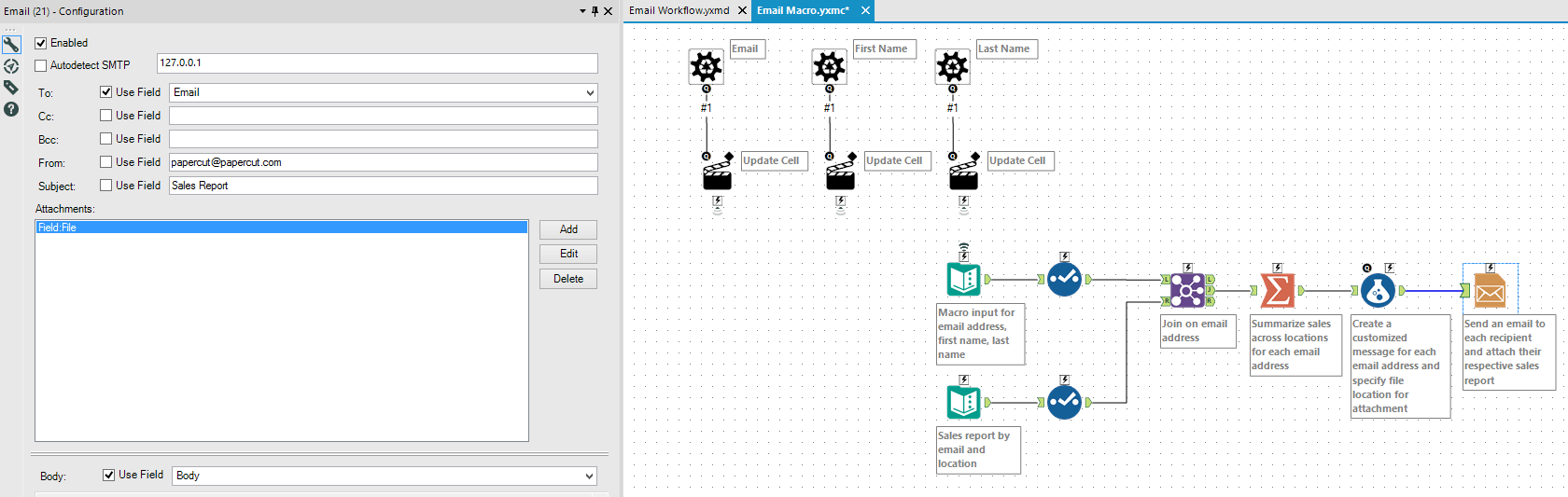
Alteryx Batch Macros Email Customized Reports to a List of Users from interworks.com
Some tools in the tool palette are macros. The macro is executed once for each record or. They allow you to take a section of a workflow that you need to repeat.
Inputs Can Be Configured To Be Used In Each Run Of The Workflow Or Only In Specific Runs.
After each run, this macro is repeated many times in a workflow, and an output is generated after each run. You can save the workflow, connect some data to it, and the whole thing will work just fine. Create a macro to save an analytic process you perform repeatedly.
This Macro Runs Multiple Times In A Workflow And Creates An Output After Each Run.
Letter input should be streaming into the control parameter (¿) input and dimension input should be streaming into the data (d) input. This variable is useful in workflow functions, it increments by 1 each time the macro runs. It is the goal of this macro to package a process in a workflow as a tool that can be used to insert it into another workflow.
The Formula Evaluates Like This:
Rather than writing more jargon, i demonstrate how i converted a standard workflow into a batch macro. The video shown below discusses all aspects of the standard workflow and how it gets converted to a batch macro. Standard macro (see it here), batch macro and iterative macro.
I Only Recently Discovered The Workflow Dependencies Window After Using The Product For Two Years, And Probably Should Have Known It Was There, But I Feel Like Tucking That.
Go to save the macro, and you’ll notice the extension is.yxmc to indicate that it is a macro. In the example shown, the formula first divides the time stamp value in b5 by 86400, then adds the date value for the unix epoch, january 1, 1970. Batch macros with more than one control parameter tool display a tab with input options for macro users.
Control Parameter Has A One Tool Example.
Most of the options in the interface designer are used with analytic apps, batch macros, and iterative. A macro is a workflow or group of tools built into a single tool that can be inserted into another workflow. It takes a different type of input called a control parameter.


Comments
Post a Comment